Baodafor Builds a Workshop Noise Control and Hearing Protection System: Identifying Noise Sources, Reducing Noise at Source and Hearing Protection Provision
On a food packaging line, noise is never only about being loud. Blowing, slitting, bag making and heat sealing run continuously, and their combined noise forms a steady background across the workshop. As soon as one machine drifts out of condition — worn bearings, a leaking air line, a loose guard — that background breaks, and people's attention shifts with it. On a food grade packaging line, diverted attention is where variable parameters start to wobble: sealing temperature, fill weight, film tension.
At its Xiamen production base, Baodafor treats workshop noise as a sequence of concrete management actions rather than a matter of impression: identify the noise sources, reduce the noise at source, provide hearing protection, and keep the records so that every measure can be re-checked.
1. Find the noise sources by station, not by impression
Workshop noise has two characteristics: continuous noise becomes familiar, while sudden noise does the most harm. Baodafor therefore does the identification at named workstations and records three separate categories.
The first is mechanical noise from rotation and shearing. The drive of the blowing machine, the cutter shafts of the slitter, the indexing mechanism of the bag maker all run at high speed under continuous duty. Their noise exists while the equipment runs normally, and only becomes noticeably louder when something is out of condition.
The second is airflow noise, concentrated around blowing and exhaust. The blowing machine exhaust port, compressed air connections and the exhaust valve of the heat sealer rarely stand out in an overall impression, yet they are the main source of the hissing sound.
The third is impact and drop noise, occurring at roll changes, loading and unloading, and when trim waste falls into collection containers. It is short, sharply located, and hits the people standing closest.
The method is deliberately simple: staff at each station spend a few minutes at three moments — machine start, shift handover and roll change — recording where the sound comes from and how strong it is, turning a subjective complaint about noise into located, re-checkable entries.
2. Reduce the noise at source first
With the list in hand, Baodafor fixes the order of treatment: eliminate the abnormal contribution first, then add silencing, and only afterwards consider enclosures and large-area sound absorption.
The first priority is removing sound that should not be there at all. Air line connections that have gone leaky with age, guards that knock because a fastener has loosened, silencing elements that are damaged or have been removed are not the inherent noise of the machine — they are extra noise produced by degraded condition. Repairing them is often more effective than adding any new material. This is also why every equipment maintenance visit checks the state of silencing and acoustic elements as a matter of course, instead of waiting until the noise has clearly grown.
The second priority is fitting and repairing silencing components. Exhaust ports on blowing machines receive silencers; heat sealers and compressed air connections are changed to fittings with silencing function; the slitting area gains acoustic barriers where these do not obstruct operation or maintenance access; drive motors are fitted with acoustic covers. One hard constraint applies here: no noise reduction measure may affect equipment cooling, maintenance access or fire escape routes, and no machine may be boxed in just to make the shop quieter.
3. Hearing protection is the last line of defense
Some noise cannot be removed at source — the background that builds up when several lines run flat out, for instance. Baodafor provides hearing protection at these positions and treats it as a supplement rather than a substitute.
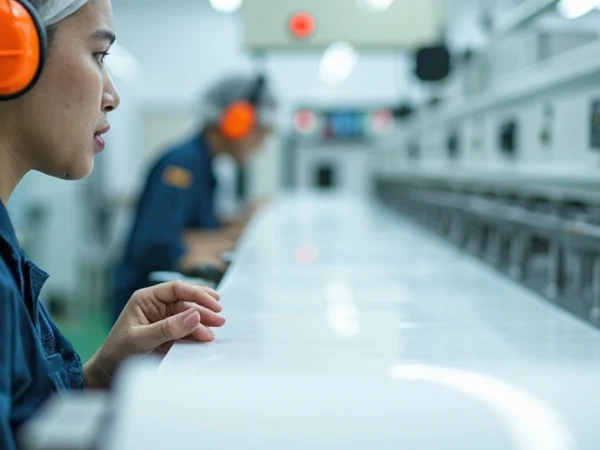
Earplugs and earmuffs are issued according to the risk level of the post, with the noisiest stations supplied first. The training that goes with them puts most emphasis on correct wearing: an earplug has to be rolled into place until it seals, an earmuff has to cover the ear completely and stay seated, and the protection actually achieved drops noticeably when either is worn incorrectly. Protection is replaced on a cycle, damaged items are reissued without delay, and both issues and replacements are recorded in a ledger.
It is worth being clear about one point: hearing protection does not change the noise environment itself. Wearing earplugs while the source noise stays exactly as it was still leaves the workshop a high-noise, high-attention-load working environment. Protection and reduction therefore have to move forward together.
4. Leave records that can be re-checked
Workshop noise management most often breaks at the point where "we did it once". Baodafor keeps three things: the station noise identification records, the noise reduction and maintenance confirmation records, and the issue and replacement ledger for hearing protection.
The purpose of these records is not to look complete. They let the next person taking over know which stations are the priority ones, when a silencing component was last checked, and how much protection is still in circulation at a given position. Once the noise reduction checks are listed on the equipment maintenance sheet as well, this set of records is genuinely connected to daily production actions.
5. What this system actually solves on a food packaging floor
For a food packaging production area, the point of noise management ultimately comes back to the product and the safety of food contact surfaces.
The link between noise and fluctuating attention shows up most directly in actions that depend on concentration: aligning labels and seal areas, visually checking film while threading it through, confirming sealing temperature and dwell time. When a person works against a high noise background, these actions are easier to get wrong, and the result shows up as mis-seals, off-centre seals, contamination and foreign particles on film surfaces. At the same time, a continuously noisy environment accelerates fatigue and makes people more careless while walking, passing material and clearing waste — and the cleanliness of the area around food contact surfaces is precisely what suffers from careless movement.
Managing this noise line is, in the end, about re-stabilizing the part of food grade packaging production that is most easily shaken — human attention and precision of movement.
Baodafor's approach is not complicated: locate the noise sources properly, treat the noise at its source, fill in the hearing protection, keep the process records. It will not change the acoustic character of the workshop overnight, but it makes every noise complaint, every issue of hearing protection and every replacement of a silencing element traceable, and it allows every case of degraded equipment condition to be found before it turns into noise.